America’s shame – the Guantanamo Bay
Anyone can become angry – that is easy. But to be angry with the right person, to the right degree, at the right time, for the right purpose, and in the right way – this is not easy. – Aristotle, The Nicomacbean Ethics
Introduction
 166 inmates currently have the privilege to be in the most expensive prison on Earth – the Guantanamo military camp. Little did they know 15 years back that they’d one day be captivated and force-fed to endure such devastating facet of life with no opportunity to demonstrate their innocence, and definitely no opportunity to leave. 9 died, 3 hanged themselves leaving behind suicide notes in Arabic. The beautiful Cuban landscapes of Guantanamo are painted in blood and the US government is readily answerable for it. Guantanamo Bay – a medical-ethics free zone – is a rather infamous aftermath of the 911 terrorist attacks. 2002 was the year when the US decided to enter this new age of warfare. With no application of the established laws of war or framework, the US’ Department of Defence readily decided that whoever would be caught in the war on terror post 911 would be put under detention preferably at the Guantanamo Bay, making it easier for the government to argue that these detainees were not entitled to protection under the Geneva Convention and US constitution, since they were placed outside the boundaries of the US jurisdiction system.
 Of 911, and things that followed
Four co-ordinated terrorist attacks made in the US on September 11th, 2001 are the flashback story of the Guantanamo excuse. 19 militants said to be associated with the Islamic extremist group Al-Qaeda hijacked four American airliners and carried out suicide attacks against major targets in The States. These attacks are generally referred to as 9/11, and are statistically said to have resulted in mass destruction and death of over 3,000 people. Two of the four hijacked planes crashed North and South towers of the World Trade Centre. A third plane crashed into Pentagon, Defence Headquarters, Washington D.C., while the fourth crashed near Pennsylvania. This 8:45 a.m. episode led to trigger major initiatives of the US government under the presidency of G.W. Bush, the Guantanamo detention being one of them.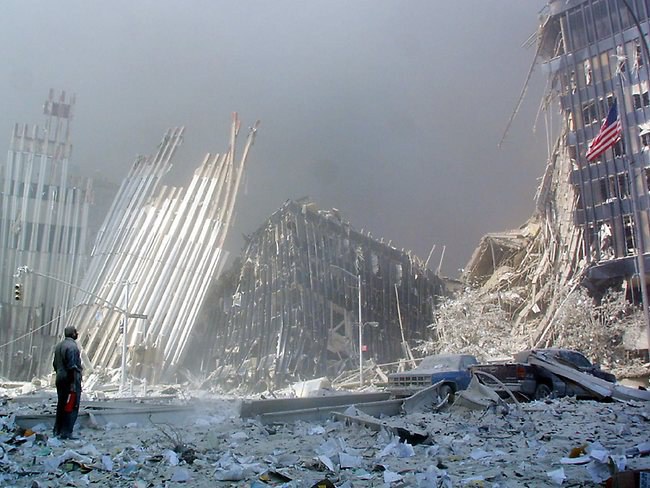 At 9 p.m. the same day, Bush declared on television, “Terrorist attacks can shake the foundations of our biggest buildings, but they cannot touch the foundation of America. These acts shatter steel, but they cannot dent the steel of American resolve.” In a reference to the
eventual U.S. military response he declared, “We will make no distinction between the terrorists who committed these acts and those who harbour them.” As a result, 780 were detained in the Guantanamo prison. Currently the number has fallen down to 166, out of which 86 have been cleared to release out but have stayed back to help drive hunger strike against the detention of the innocent. Defending the abuse these detainees undergo, Bush once said, “Terrorists that once occupied Afghanistan, now occupy Guantanamo Bay”. Only 10 of the entire detained population are undergoing criminal charges. Why the rest of them have been captivated and are being tortured has no answer!
At 9 p.m. the same day, Bush declared on television, “Terrorist attacks can shake the foundations of our biggest buildings, but they cannot touch the foundation of America. These acts shatter steel, but they cannot dent the steel of American resolve.” In a reference to the
eventual U.S. military response he declared, “We will make no distinction between the terrorists who committed these acts and those who harbour them.” As a result, 780 were detained in the Guantanamo prison. Currently the number has fallen down to 166, out of which 86 have been cleared to release out but have stayed back to help drive hunger strike against the detention of the innocent. Defending the abuse these detainees undergo, Bush once said, “Terrorists that once occupied Afghanistan, now occupy Guantanamo Bay”. Only 10 of the entire detained population are undergoing criminal charges. Why the rest of them have been captivated and are being tortured has no answer! The Geneva Convention, by word, and intervention of the US
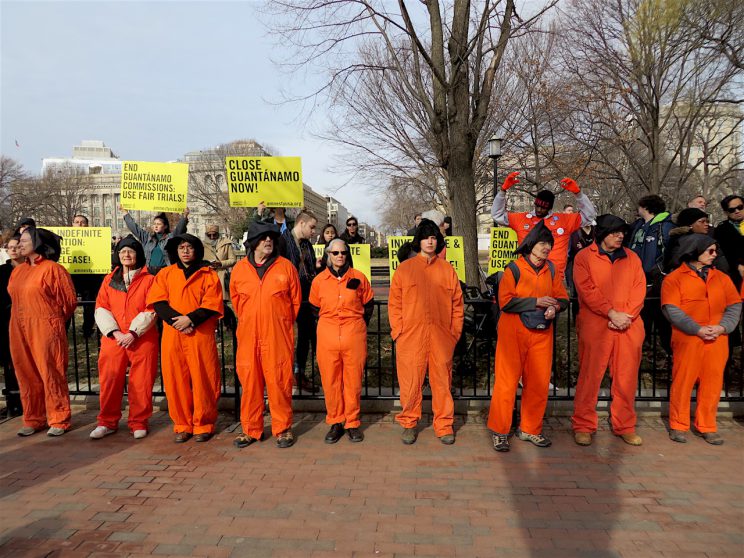
The Geneva Convention is the humanitarian touch to war ethics that came into existence after the Second World War in 1949. It comprises of four treaties, and three adjacent protocols that set international standards for humanitarian treatment in times of war, and extensively define the basic rights of wartime prisoners. When it came to the War on Terror, the US federation misled the Geneva Convention in enormous ways. Detaining the captivated in Guantanamo, instead of the US soil was a clever midway tactic to keep the Constitution and Convention unperturbed. The inside stories of treatment of the captives at the detention camp portray what is far from human, ranging from all sort of physical, emotional, even sexual and religious harassment. Accounts of this inhumane treatment tell tales of hooded, goggled, shackled men in orange jumpsuits, all knelt down before fence wires, in the likeness of Muslim prayer position. The stories scream of systematic abuse, while the military personals openly admit that many of these detainees don’t even belong here in the first place. “You are in a place where there is no law – we are the law”, say the US military intelligence officers at Gitmo. The US government classifies these detainees as enemy combatants. They yet have no answer to how majority of these detainees have ever been involved in threatening the peace of their nation. Quite a number of these detainees are known to be captivated as minors, having spent years as prisoners at Guantanamo. These prisoners, undergoing interrogation have been put to solitary confinement for periods exceeding a year, have been deprived of sleep for days, weeks and even months, exposed to extreme temperatures, raped, threatened, beaten, deprived of medical treatment for serious clinical manifestations, and harassed in so many other possible ways. The overall expense of running the Guantanamo detainment facility, by the end of 2014, mounted up to $5.242 billion, more than the estimated GDP of several countries that very year. Yearly cost estimate for taxpayers of a prisoner in a maximum-security federal prison is nearly seventy-eight thousand dollars. Yet, for the longest possible amount of time, US Presidency made sure that this act was not put down in whichever possible ways. Bush and his loyal Congress counterparts kept on defending the inhumane treatment of the prisoners at the camp, though evidences of the government violating international laws kept coming to light throughout that decade. The US government kept on arguing for years that the detention at Guantanamo was not only beyond the reach of the American civil law but also the Geneva Convention, or any other international humanitarian act or law. Guantanamo talk under Obama Presidency With the end of Bush’s Presidency, as Obama came to power, he suggested that Bush’s policies of detention and power grab of execution were not very lawful. He also vouched to cut through this detention and bring America’s shame to an end. He said, “It’s time to better protect the American people and our values by bringing swift and sure justice to terrorists through our courts and our Uniform Code of Military Justice.” By signing an executive order as a promissory act to close the Guantanamo Bay within the first year of his presidency, Obama lived up to global expectations. But 5 years down the lane, seeing that Gitmo is still very operational, one must take a moment to comment over where Obama failed to keep his word! Factually, Obama is said to have received severe backlash over his motive of shutting the prison down, but continued that he still is very committed over getting the prison closed. The detainees’ lawyers however came up with the remark that the President did not live up to his word. Failing at his rhetoric, Obama gained a reputation of being worse than Bush, among the detainees with wounded sentiments. They prompted that the psychological hurt they underwent during Obama’s presidency was worse than the physical torture inflicted during Bush’s. At multiple conferences, Obama kept on reiterating his promise to redouble his efforts to close Guantanamo, up to no avail. He suggestively stated that the Congress has interfered with his ability to shut the camp. This has some truth to it.Guantanamo and the call of Trump